
RISE in Practice
How to Be Monday Morning Resilient
If Sunday night dread is already creeping in, take a few minutes to read this — it walks you through RISE, step by step, so Monday can feel steadier instead of heavier.
Davina Lyons · November 1, 2026 · 5 min read
You know the feeling.
It's Sunday evening. The weekend isn't quite over, but your stomach already knows it's ending. You start running through Monday in your head — the emails, the meetings, the students, the deadlines, the conversation you've been avoiding — and the dread settles in like a weight.
Let's name this plainly: that dread doesn't mean you're lazy. It doesn't mean you're ungrateful for your job. And it doesn't mean you're failing at resilience.
Most of the time, it means your system is tired, and Monday is asking for more than you have left to give.
That's exactly what the RISE Framework is for. Not to push you harder through Monday, but to help you meet it with a steadier nervous system and a clearer plan.
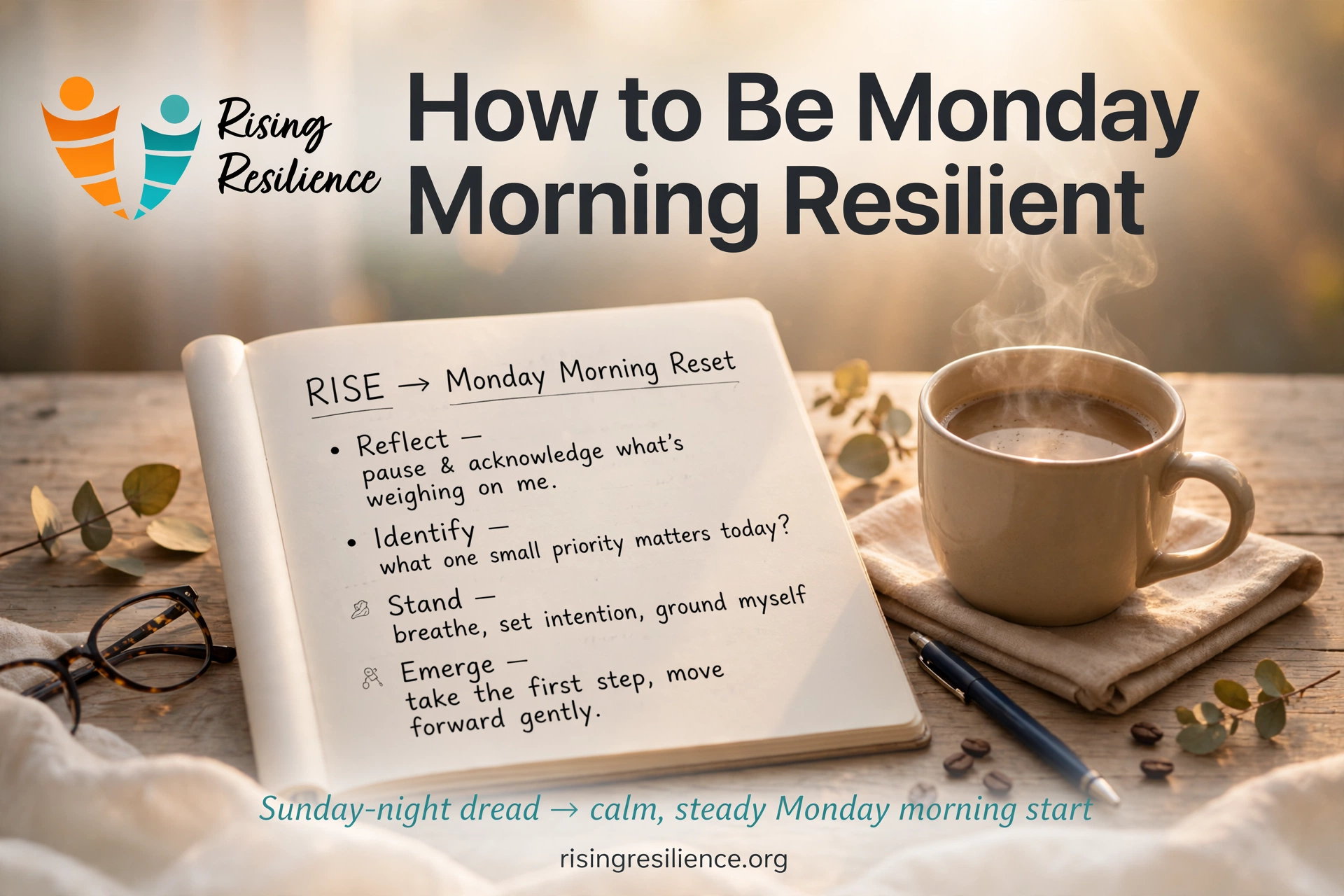
RISE stands for Reflect, Identify, Stand, Emerge. Here's how to use it when Monday dread shows up.
Reflect: Notice it before it runs the night
Dread gets louder when we try to ignore it. So start by pausing, not fixing.
On Sunday evening, take two quiet minutes and ask yourself:
Where do I feel this in my body? Tight chest? Heavy shoulders? Restless mind?
What thought keeps looping?
Am I actually dreading all of Monday, or one part of it?
You don't have to solve anything yet. Just notice. Reflection turns a vague, all-weekend dread into something specific enough to work with.
Try this: feet on the floor, shoulders down, one slow breath in and a longer breath out. Let your body know you're safe right now, even if tomorrow feels big.
Identify: What's Monday really asking of you?
Dread is rarely about Monday itself. It's usually about one of these underneath:
Too much. The list is longer than the day, and you already know you can't finish it all.
A hard moment. A difficult conversation, a challenging class, a meeting you're not looking forward to.
No control. A schedule that was handed to you, with no room to breathe between demands.
A tired body. You didn't really rest this weekend, so Monday feels like starting on empty.
A values pinch. You're spending your energy in ways that don't match what matters most to you.
Pick the one that fits best. Not all five. Just the truest one.
That matters because we can't fix "everything." We can work with one honest root cause.
Ask: If Monday went a little better, what would actually need to change? The answer is usually smaller than the dread makes it seem.
Stand: Protect your energy on purpose
Standing isn't about standing tall and powering through. It's about standing in what you can control, and setting a boundary around what you can't.
Here are three small stands that make Monday mornings different:
1) Make Sunday night 10 minutes, not the whole night.
Write down tomorrow's top one thing — not ten. Lay out what you need. Then close the notebook. Dread loves an open loop. Closing it on purpose tells your brain, "I've got a plan. We can rest now."
2) Give Monday a slow first 10 minutes.
Before you check email, before you fix everyone else's problems, anchor yourself. A short walk, a cup of coffee in quiet, a few deep breaths, your normal morning rhythm. That first 10 minutes sets the tone for your nervous system for the rest of the day.
3) Don't fill every gap.
Monday will try to fill itself. Leave one gap on purpose — between meetings, after lunch, before you head home. That space isn't wasted time. It's how you stay regulated enough to actually show up well for the people who need you.
Standing is not selfish. It's sustainable.
Emerge: Walk into Monday as a first step, not the whole week
Monday morning resilience doesn't mean you love Mondays. It means you have a way through them that doesn't cost you the whole week.
Try this simple Monday rhythm:
One anchor. Start with the thing that steadies you, not the thing that stresses you.
One priority. Do the one thing that matters most first, or at least first on purpose. The rest can wait its turn.
One kindness to yourself. A real lunch break. A walk outside. Leaving on time, even if the list isn't done. You are not the list.
And when the dread voice says, "You can't handle this week," answer it with what's true: "I don't have to handle the whole week. I just have to handle this next step."
That's resilience. Not never feeling dread. Knowing what to do when it shows up.
Monday doesn't have to swallow you
If Sunday night dread has become your normal, that's information, not a character flaw. Your body and your work are asking for a different rhythm — one that protects your energy instead of spending it all by Tuesday.
You can start small, this week. Reflect for two minutes. Identify the one true thing. Stand with one boundary. Emerge one step at a time.
And if you want help building a system around that — not just a better Monday, but a calmer way of working — that's what we do here.
Support parents. Value teachers. Empower students — together we RISE.
Learn more about the RISE Framework at https://risingresilience.org/rise/
Not sure where to start? Take Find Your Fit: https://risingresilience.org/find-your-fit/
Join us for the New Year RISE Reset, virtual Saturdays January 9, 16, 23, and 30, 2027, 10:00–11:30 AM Phoenix: https://risingresilience.org/new-year-rise-reset/
Continue the conversation. Explore practical tools or find the support that meets you where you are.